

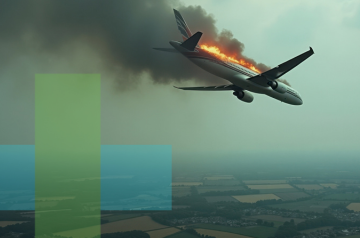
3.8 Plane Crashes a Day: The Math Healthcare Cannot Ignore
Consider the impact if three fully loaded Boeing 737s crashed in a single morning, resulting in total loss of life.
Such an event would halt global air travel, prompt immediate investigations, and dominate news coverage. Authorities would respond urgently to prevent further incidents.
Now, imagine this scenario repeating daily, with three crashes every day throughout the year.
In aviation, this would be catastrophic. In healthcare, it has become a normalized statistic.
Research indicates that preventable medical errors are the third leading cause of death in the United States, resulting in over 250,000 deaths each year. This equates to 3.8 airline crashes per day.
As a cardiac surgeon with over 34 years of experience, I have dedicated my career to patient care. However, I have also witnessed systemic issues that compromise safety, often due to gaps in training and skill retention rather than a lack of commitment.
A key difference between aviation and medicine in terms of safety is the use of simulation.
The Numbers We Cannot Ignore
In 2016, researchers at Johns Hopkins published a landmark study in The BMJ estimating that medical errors cause more than 250,000 deaths per year in the United States. If accurate, this would make preventable medical errors the third leading cause of death, behind only heart disease and cancer.
To put this in perspective: commercial aviation moves over 900 million passengers annually in the United States alone. In 2023, there were zero fatal accidents on U.S. commercial airlines. The fatal accident rate globally is now less than 0.1 per million flights.
In contrast, healthcare affects nearly every American, yet preventable errors in diagnosis, treatment, medication, and procedures result in annual losses equivalent to the population of a mid-sized city.
The issue is not whether these numbers are acceptable—they are not. The real question is: what has aviation implemented that healthcare has not?
The Flight That Changed Everything
On December 28, 1978, United Airlines Flight 173 was approaching Portland, Oregon, when the crew noticed a problem with the landing gear. The captain became so fixated on troubleshooting the issue that he lost track of fuel levels. Despite multiple warnings from his crew, he failed to act. The plane ran out of fuel and crashed into a suburban neighborhood, killing 10 people.
A technical failure did not cause this crash; instead, it was a communication breakdown.
The crew knew they were running out of fuel. They tried to alert the captain. But the hierarchical cockpit culture prevented them from being direct enough to break through his fixation.
This incident marked a turning point. The National Transportation Safety Board investigation led to the development of Crew Resource Management (CRM) in aviation training.
The key insight was that technical skill alone is insufficient. Teams must be trained to communicate effectively, challenge authority when necessary for safety, and perform under pressure.
CRM extended beyond communication. Aviation adopted simulation as the foundation of competency. Pilots now spend extensive hours in flight simulators before carrying passengers, practicing various emergency scenarios until correct responses become automatic.
Importantly, this training is ongoing. Even experienced captains with 20,000 flight hours must complete simulator training every six to twelve months to maintain certification.
The concern is not that experienced pilots forget how to fly, but that skills deteriorate without practice. Discovering diminished competency during an actual emergency carries unacceptable risk.
Aviation prioritizes ongoing competency maintenance, rather than relying solely on periodic certification.
The “See One, Do One” Trap
For decades, medical training has relied on a very different philosophy, captured in the adage: “See one, do one, teach one.”
We train competent individuals through rigorous education, including medical school, residency, and often fellowship. However, during residency, most training occurs on real patients with minimal simulation.
Eventually, traditional supports are removed. Training often relies on lectures, digital resources, and basic manikins that do not replicate the urgency or unpredictability of real emergencies. Providers are then placed in high-stress environments and expected to perform flawlessly.
Eventually, traditional supports are removed. Training often relies on lectures, digital resources, and basic manikins that do not replicate the urgency or unpredictability of real emergencies. Providers are then placed in high-stress environments and expected to perform flawlessly.
We expect flawless performance in situations that providers may have only observed or studied, rather than practiced.
Compare that to aviation. Pilots never step into a cockpit with passengers until they have logged countless hours in a simulator. They practice engine failures. They practice wind shear on the final approach. They practice crew incapacitation and rapid decompression. They are allowed to crash in the simulator, so they never crash in the sky.
In medicine, this opportunity is rare. The learning curve often occurs on real patients.
The Skill Decay Problem
Another significant issue is skills decay, which is often overlooked.
The American Heart Association has documented that CPR skills begin to deteriorate within three to six months of training. A provider who was certified in January may not be competent in July. Yet most healthcare organizations recertify staff only every two years.
This is not a matter of intelligence or dedication; it reflects the nature of human memory and motor skills. Without regular practice, performance declines.
Healthcare has been slow to acknowledge this reality. Providers are certified with the assumption that competency endures until the next cycle, and assessments often focus on written exams rather than real-world performance.
We rely on hope that providers will respond correctly in critical moments, but hope is not a reliable strategy.
The Evidence for Immersive Training
Fortunately, there is now strong evidence supporting a more effective approach.
A 2019 systematic review and meta-analysis published in the Journal of Medical Internet Research examined 31 randomized controlled trials of virtual reality in health professions education. The findings were striking: VR training improved knowledge scores compared to traditional learning, with a standardized mean difference of 0.44.
More importantly, VR training improved skills acquisition with a standardized mean difference of 1.12—a large effect size by any measure.
Other studies have shown that high-frequency, low-dose training—short simulation sessions repeated regularly—produces better retention than traditional massed training. The principle mirrors what aviation has long practiced: distributed practice beats cramming.
We also know that stress inoculation matters. Providers trained under realistic, high-pressure conditions perform better during real emergencies. The chaos of a code blue is not the time to experience that level of stress for the first time.
The Era of Immersive Medicine
For these reasons, we are entering the era of Immersive Medicine.
Virtual Reality in healthcare is not a novelty; it serves as healthcare’s equivalent of the flight simulator. VR enables nurses and surgeons to experience highly realistic scenarios, providing effective stress inoculation.
We can replicate the chaos of the emergency department, the pressure of a pediatric arrest, and the complexity of a multi-system trauma. We can introduce distractions, interruptions, and complications that mirror real clinical environments.
Equally important, VR enables real-time competency assessment by objectively evaluating decision-making and psychomotor skills under pressure, rather than relying on written tests.
Most importantly, VR in medical training allows trainees to make mistakes, observe consequences, and try again, building muscle memory without endangering patients. They learn the impact of hesitation, missed steps, and communication failures in a safe environment.
VR also standardizes training, ensuring that nurses in rural hospitals receive the exact high-quality simulation as those in major centers. This approach democratizes access to competency.
What Immersive Medicine Looks Like in Practice
Immersive Medicine is not a single technology. It is a new paradigm for training, assessing, and maintaining competency in healthcare.
- Training: Rather than relying on annual recertification through written exams, providers participate in regular simulation sessions, such as Virtual Reality CPR training, often monthly or weekly, to maintain and reinforce essential skills. These sessions are brief, focused, and integrated into daily workflows.
- Assessment: Competency is measured through actual performance, using biometric data, decision timing, procedural accuracy, and team communication. Performance is evaluated with weighted scoring, shifting the focus from credentials to real-world ability.
- Continuous Improvement: Simulation data informs training design. If providers consistently face challenges in specific scenarios, training is adjusted accordingly, allowing the system to learn and improve.
- Stress Inoculation: Providers experience realistic pressure in simulation, learn their stress responses, and develop coping strategies, ensuring real emergencies are not their first exposure to such intensity.
This is not a distant vision; the technology and supporting evidence exist today. The remaining challenge is whether healthcare will choose to adopt it.
The Path to Zero
We cannot accept 250,000 preventable deaths per year as the cost of doing business. We cannot shrug at 3.8 plane crashes’ worth of fatalities every single day and call it inevitable.
We have the technology to save lives. We have tools that let providers practice real-life clinical scenarios before they face them in practice.
We have decades of aviation evidence showing that simulation-based training, combined with a culture of continuous competency verification, can drive fatal-error rates toward zero.
The barriers are not technical, but cultural, organizational, and financial. They stem from resistance to change and the assumption that capable individuals will perform well under pressure without ongoing practice.
Aviation addressed these barriers after major tragedies prompted industry-wide change. Healthcare faces its own tragedies—250,000 annually—but these are often dispersed, less visible, and recorded as “complications” rather than system failures.
It is time to recognize these issues, acknowledge the actual cost, and demand improvement.
Aviation determined long ago that preventable deaths are unacceptable. Healthcare must now make the same commitment.