

The AI That Knows If You’ll Freeze
By Farzad Najam, MD, FACS | Founder & CEO, VRKure | Clinical Professor of Surgery, George Washington University
The Moment That Defines a Career
As a cardiac surgeon, I have lived a life over 26 years where performance under pressure is the crux of what we do. There were moments where I would not even have time to think — decisions had to be made, with accuracy, at a split second, and those decisions carried the full weight of a human life. I never had the option of freezing. The stakes were too high.
When someone freezes in those moments, wrong decisions are made. The brain commits to faulty decision-making that can have serious, irreversible consequences. Medicine has always relied on physicians and nurses to have an innate ability to perform high-risk tasks under immense pressure, with flawless decision-making. That is only possible with an enormous wealth of experience — and not everyone has the good fortune of having that.
What medicine has gotten wrong is the competency gap. Competency measurement is subjective. No tools exist — other than practicing on real patients — to practice, track, and verify one’s skills over time. We have accepted that gap as inevitable. It is not.
What Other Industries Got Right
Aviation, nuclear power, military special operations, NASA — all of them practice relentlessly, and not only hone their skills but measure those skills against an objective yardstick before the actual event, because the consequences of failure are dire.
Aviation tracks decision latency, skill decay curves, checklist adherence under cognitive load, and startle response time. Military special operations tracks stress inoculation response, how performance degrades across repeated high-stress exposures and how quickly it recovers. What all of these industries share is this: they measure the gap between what someone knows and what they actually do when the body is under physiological stress.
Medicine has been left behind. Every other high-stakes industry has built infrastructure focused on skills and competency. Medicine has remained content with static learning methodologies that check a box and call it done.
What the Technology Actually Does
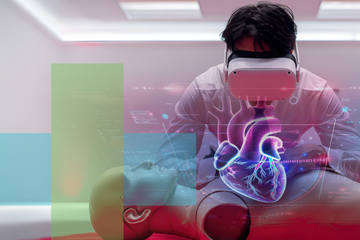
VRKure is building a platform and infrastructure that goes far beyond traditional simulation into the realms of immersive medicine. It begins with immersive learning, not reading from a screen, but experiencing the environment. It moves through guided simulations with real-time feedback and corrective cues. And then it does something no other platform does: it continuously tracks performance, measures skill decay, and generates a dynamic, competency-based certification that relies on high-frequency, low-dose training rather than annual box-checking.
AI measures and tracks one’s skills over time, predicts decay before it becomes dangerous, and triggers targeted remediation before a clinical failure occurs.
This is not simulation training. This is knowledge, training, practice, skills tracking, and competency verification, all in one platform.
What the Data Actually Captures
Our BLSXR platform captures what no written test, human observer, or basic manikin can: hand placement precision, chest compression depth, compression rate, chest recoil completeness, ventilation rate, and AED management sequence and timing, all measured continuously, objectively, and against established clinical benchmarks.
A written test cannot see that your compression depth is 1.6 inches instead of 2. A human observer can estimate it but cannot measure it consistently across providers or over time. A basic manikin gives you a green light or a red light — pass/fail — with no longitudinal record, no individual baseline, and no ability to detect that your compression rate has degraded 15% since your last session six months ago.
Using medical simulation training, VRKure captures the actual physical execution of the skill, repeatedly, with precision, over time. That trajectory — how technique holds up, degrades, or improves across sessions — is what predicts real performance. Not a snapshot. Not a score. A performance curve.
The current state of healthcare testing is like a resting ECG. It captures a single moment in time. VRKure provides the stress test. It applies demand — a deteriorating patient, a time-pressured scenario, a high-stakes sequence — and measures how performance holds up under that load. The gaps that were invisible at rest become visible under pressure. And catching the finding before the event is the entire point.
Why Right Now
Resident hours have decreased. The load on nurses has significantly increased. The population is aging while the healthcare workforce is shrinking. Demands have grown while the infrastructure for verifying competency has stood still.
Human error cannot continue to be one of the leading causes of mortality. Competency levels in medicine are not where they need to be, and the system has no reliable mechanism to see that, let alone correct it. There are staffing pressures and economic pressures that quietly compromise patient care every day.
Providers don’t fail. The system fails the providers — and their patients. If healthcare continues to wait and do nothing, the cost, measured in human lives, will be exponential. That is not acceptable.
From Reactive to Predictive
The current model certifies attendance. We read from a screen, watch a video — often fast-forwarded — take a quiz, pass after a few attempts, and receive a certificate. The model focuses entirely on completing a task, not on imparting or testing competency. The certificate is issued. The skill is assumed. The gap is invisible.
VRKure’s platform trains in virtual reality — walkthrough instruction, guided simulation, live performance with real-time feedback and corrective cues — and then conducts VR competency tracking continuously. Skill decay is predicted before it becomes dangerous.
Consider this: a nurse recertifies in January — passes, box checked. By June, VRKure has tracked three medical simulation training sessions and flagged a 16% decline in compression depth, incomplete chest recoil, and a drifting compression rate. Her training coordinator receives an alert and schedules a targeted 30-minute remediation session. She corrects. The patient who codes on her floor in August receives adequate compressions. No incident report is ever filed — because the system caught the gap six weeks before it mattered.
The Ethical Obligation
After 26 years of cardiac surgery, I feel a profound obligation to affect patient care positively — not individually, one patient at a time on my table, but globally. I want to bring about a change that helps patients everywhere, long after I have left the operating room.
When patients are admitted to a hospital, they deserve to know that the providers caring for them are certified for their competency — not just their attendance. That is a reasonable expectation. We have simply never built the infrastructure to meet it.
To the leaders in healthcare: stop accepting the certificate as proof of competency. They are not the same thing, and the gap between them is where patients get hurt. Pilot one cohort. Run longitudinal simulation with objective performance tracking. Look honestly at what the data shows. The providers in your system are not the problem. The system that cannot see their performance gaps is. You have the authority to fix that.
What Comes Next
AI monitoring is not a tool to punish physicians or nurses. It is a tool to help them. Pilots look forward to simulator training and competency tracking because it sharpens their skills and gives them confidence. VRKure is built with the same intention — to support providers, not surveil them.
Immersive Medicine is the discipline that will define the future of clinical training, competency tracking, skill decay modeling, and ultimately diagnostics and therapeutics. It is not a distant vision. It is being built now.
The technology to verify real competency exists today. The only remaining question is whether you will demand it before or after the next preventable death on your floor forces you to.
Farzad Najam, MD, FACS is the Founder and CEO of VRKure and Clinical Professor of Surgery at George Washington University School of Medicine. With over 10,000 surgical procedures and 26 years in cardiac surgery, he is a leading voice in Immersive Medicine and AI-powered clinical competency verification.