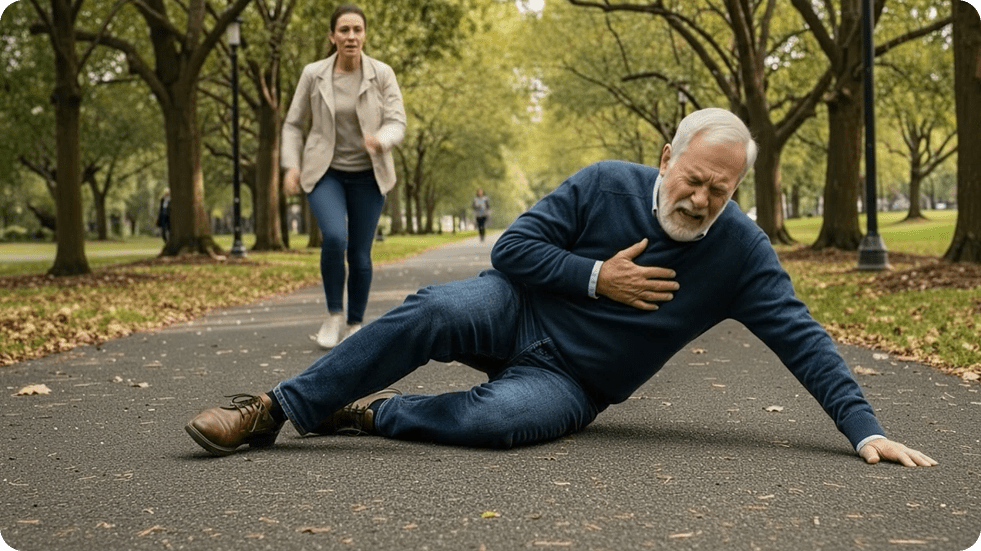
Train Like It’s Real.
Because One Day
It Will Be.

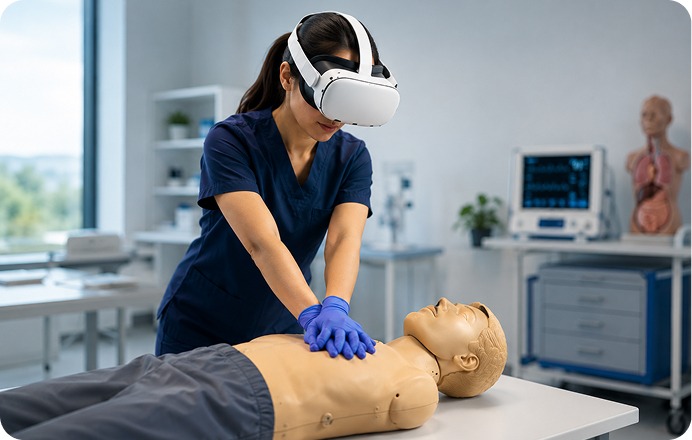
BLSXR™ is the world’s first AI-powered, immersive extended reality platform for Basic Life Support (BLS) training – delivering measurable competency and skill decay, not just certification checkboxes.

Train Like It’s Real

Key Features

Immersive BLS Training VR Environment

  • Fully simulated clinical scenarios delivered via XR headsets (ERs, hospital corridors, public spaces).
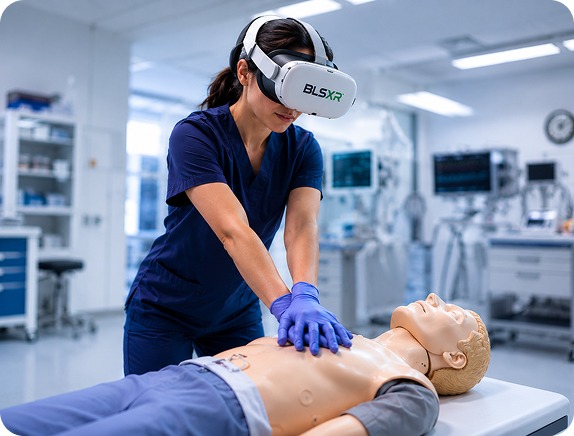
  • Trainee is physically present in the simulation — not watching a video or using static mannequins.
  • Scenarios incorporate time pressure, environmental noise, bystander variables.
  • Includes realistic deterioration cues mirroring real-world cardiac arrest events.

AI-Architected Platform with Adaptive Layer in Development

  • Architected around an AI layer to dynamically adjust scenario difficulty based on real-time performance.
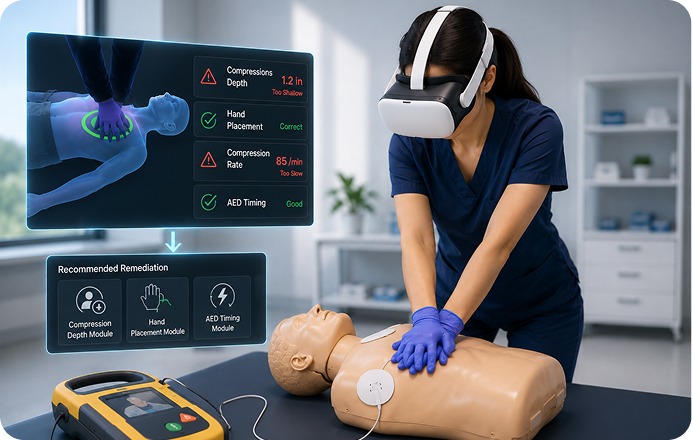
  • Identifies technique gaps, adapts scenario pacing, generates post-session remediation pathways.
  • Adaptive engine is patent-protected, in active development; represents next phase of platform evolution.
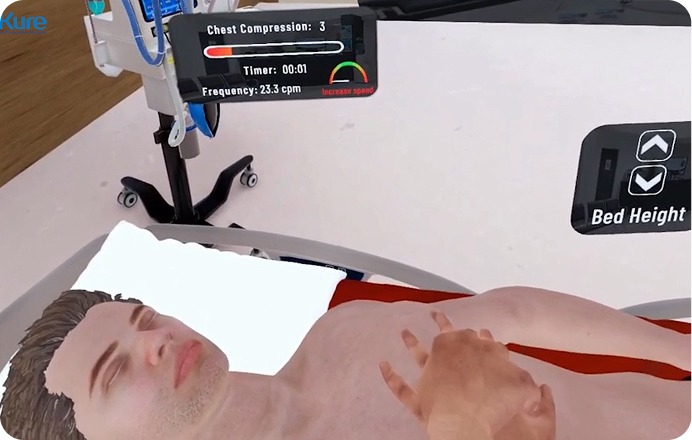
  • Current version delivers structured, scenario-based training with real-time biomechanical feedback.
  • AI-driven personalization layer planned for upcoming release.

Performance Analytics & Reporting

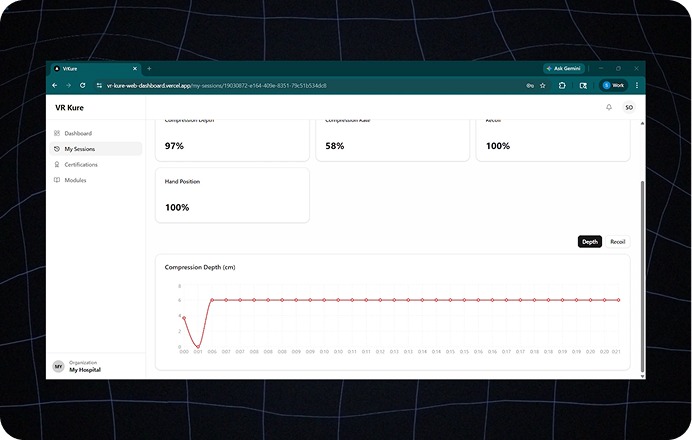
  • Tracks compression depth, rate, and recoil across every session.
  • Exportable competency reports for instructors and accreditation bodies.
  • Progress dashboards highlight improvement trends over time.

Scalable Multi-User Deployment

  • Roll out standardized training across multiple sites simultaneously.
  • Centralized admin controls for cohorts, licenses, and content.
  • Cloud-synced so every trainee runs the same up-to-date scenarios.

Benefits

Improved Skills Retention

Improved Skills Retention
Reduced Training Costs

Reduced Training Costs

No Real Patients Required

No Real Patients Required
Objective, Defensible Performance Data

Objective, Defensible Performance Data

Immediate Remediation

Immediate Remediation

Straight from Our Clients

BLSXR™ vs. Traditional BLS Training

Dimension

Performance Measurement

Scalability

Scenario Variety

Cost Model

Skill Retention

Data & Compliance

Patient Safety Risk

Repeatability

BLSXR™

Traditional BLS Training

Subjective, instructor-observed

Limited by instructors and physical space

Standardized; rarely varies

High fixed cost per cohort

Rapid decay without reinforcement

Attendance records only

Real patients or expensive sim labs

Annual or biennial

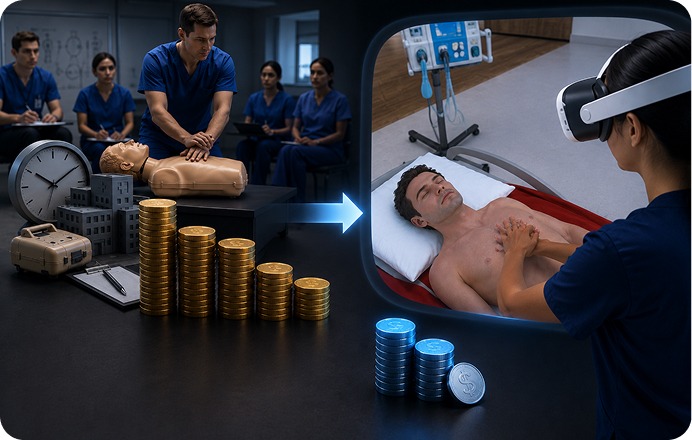
The Core Differentiator: From Certification Theater to Real Competency

The entire healthcare training industry has optimized around a broken model:

BLSXR™ was built on a fundamentally different premise – that the only thing that matters is whether a clinician can actually perform when a patient’s life depends on it. Every design decision in this virtual reality BLS competency platform flows from that premise.

BLSXR™ doesn’t replace certification. It makes certification mean something.

The Core Differentiator: From Certification Theater to Real Competency

Key User Segments

See BLSXR™ in Action

Discover how teams use BLSXR™ to simplify 
workflows and improve decision-making at scale.

Rectangle 4827

See Faster, Smarter Operations in Action

Frequently Asked Questions

BLSXR is a VR medical training platform tailored for clinical educators and healthcare administrators. Unlike traditional manikin-based training, it integrates immersive extended reality (XR) technology with motion tracking, providing clinicians with a dynamic and precise learning experience. The platform offers scalable training across multiple departments, enabling institutions to maintain consistent training standards while tracking real-time performance metrics. The system is designed for ease of deployment in hospital settings, requiring only XR headsets and motion-tracking sensors.

BLSXR is equipped with medical error prevention technology that provides real-time feedback on critical skills such as chest compressions, airway management, and defibrillation. The platform tracks each action with precision, ensuring clinicians meet evidence-based standards such as depth, rate, and recoil in CPR. By offering immediate corrective guidance, BLSXR reduces the likelihood of common errors, improving clinical competence and patient outcomes. Regular performance reviews also help identify skill decay, preventing errors before they impact care delivery.

BLSXR enhances training outcomes in high-risk environments by integrating medical error prevention technology that addresses key challenges in resuscitation training. The platform’s real-time error detection and correction loop ensures clinicians perform life-saving techniques accurately, reducing the likelihood of clinical mistakes during critical interventions. By continuously tracking and measuring competencies such as chest compression quality and AED use, BLSXR helps improve skill retention and ensures clinicians are always prepared for emergency situations, significantly lowering risks of errors during patient care.

Yes, BLSXR seamlessly integrates with most institutional training frameworks. The platform supports LTI and SCORM standards for compatibility with Learning Management Systems (LMS). Our team works closely with your institution to ensure smooth integration, whether your system is custom or legacy-based. This flexibility enables healthcare administrators to incorporate BLSXR’s VR medical training platform into their current workflows, enhancing training consistency without disruption to existing protocols.

BLSXR collects detailed, real-time performance data on each clinician’s actions during training. This includes metrics on compression depth, rate, recoil, ventilations, and AED protocol compliance. The platform’s medical error prevention technology continuously monitors for deviations from the standards, providing instant corrective feedback. Data is stored securely and can be used for performance reviews, targeted coaching, and identifying skill gaps. For healthcare administrators, this data provides insight into individual clinician progress and ensures compliance with institutional competency standards.

Founder Credentials

Farzad Najam, MD, FACS

Farzad Najam, MD, FACS

Founder & CEO, VRKure

BLSXR™ was founded and designed by Farzad Najam, MD, FACS – a cardiac surgeon with 26+ years of clinical experience, more than 10,000 procedures performed, and 14-time recognition as a Washingtonian Top Doctor.

Dr. Najam is a Clinical Professor of Surgery at the George Washington University School of Medicine and the former Chief of Cardiac Surgery at the George Washington University Hospital. As course director for ECMO (extracorporeal membrane oxygenation), Dr. Najam directly observed the structural gap between certification and real performance under pressure – the founding thesis behind BLSXR™.

BLSXR™ was built by a surgeon who has lived the gap between training and readiness – not by technologists guessing at clinical needs.

Academic Affiliation

  • George Washington University School of Medicine – Clinical Faculty Affiliation
  • Cleveland Clinic-trained surgical program (Dr. Najam’s training institution)
  • 45+ peer-reviewed publications in cardiovascular medicine and surgical education
  • Co-author, BMA Medical Book of the Year (robotic surgery, 2009)

Intellectual Property Protection

VRKure holds five provisional patents protecting the core technologies of the BLSXR™ platform, including:

  • AI-driven performance analytics engine
  • Biomechanical real-time feedback measurement system
  • Adaptive scenario generation architecture
  • Competency verification and credentialing framework
  • Immersive stress inoculation training methodology

USPTO filings are active; international trademark protection is being pursued across the Philippines, UAE, Qatar, Singapore, and Saudi Arabia under the Madrid Protocol.

Industry Context & Standards Alignment

  • Platform designed to align with American Heart Association (AHA) BLS performance guidelines
  • Performance metrics calibrated to AHA 2020 CPR Guidelines (compression depth, rate, recoil standards)
  • Training methodology informed by peer-reviewed literature on simulation-based medical education (SBME)
  • Scenario design references military stress inoculation training protocols validated in combat medicine research