
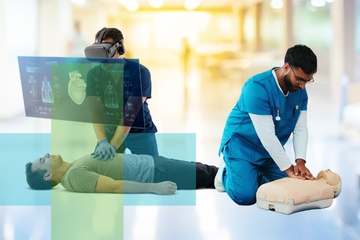
I spent twenty-six years as a cardiac surgeon. I have been in operating rooms and ICUs more times than I can count when someone was doing CPR on a patient. And I can tell you — the thought was not occasional, it was not situational. It was constant. Every time. All the time.
There is no other field where the training ground and the assessment tool are the same thing: the patient. You practice on patients. You get checked on patients. When it comes to CPR training for hospital staff, the manikin in the conference room is not preparation for that moment — it is a theater that gives everyone permission to believe preparation happened.
There is no way to practice other than on patients. There is no way to check for competency other than on patients. That is the system we built — and it has never been good enough.
This post examines what research confirms about that system — and what a different approach enables. The data cover four areas: CPR skill decay, performance under stress, simulation results, and patient survival. Together, they demonstrate why immersive, technology-enabled training is not a luxury upgrade to BLS certification. It is the change the system has needed for sixty years.
1. The Certification Is the Biggest Farce in Medicine
When someone mentions having a current BLS card, I don’t think, “This person is ready.” I think: this person attended a class. Whether those are the same thing is, at best, uncertain — and research confirms that this uncertainty is completely justified.
A 2023 study found that CPR skills start to decline as early as two weeks after training. Knowledge retention generally drops between one month and six months. At the twelve-month point — still a full year before recertification is due — only 15 to 20 percent of people retain high-quality CPR skills after a single training session.
Let that sit for a moment. The certification remains valid for two years, but the skills it certifies tend to fade within weeks. The American Heart Association’s own scientific literature clearly explains this gap: current standardized courses are inadequate, providers’ skills decline over time, and this leads directly to suboptimal clinical care and poorer survival outcomes.
That is not a criticism from the outside. That is the institution that created the standard, acknowledging that the standard does not hold.
The deeper issue is what the manikin measures. A passing score on a standard BLS assessment indicates that the learner achieved appropriate compression depth and rate during a structured, calm, supervised evaluation. It does not assess whether those mechanics hold up a month later, a quarter later, or at the moment the learner is over a coding patient, adrenaline flooding their system, and a team waiting for guidance.
BLSXR, our BLS training platform, was designed based on this evidence base. The platform records real-time compression depth, recoil, ventilation rate, hand placement, and AED management — not as a one-time snapshot, but as an objective, repeatable record of performance over time. When skills decline, the system shows it. When a learner is not prepared, the data indicate it. A biennial card cannot do either of these things.
2. Training Hours Are Shorter. The New Generation Is Less Prepared. And Nobody Wants to Say It.
There is a second aspect to this issue that I observed develop over my career in real time. Training hours have been shortened. Duty hour restrictions, curriculum pressures, and the move toward online and self-directed learning have all decreased the hands-on experience that past generations of clinicians gained. The outcome is a new group of healthcare providers who are less experienced — and a certification system that cannot tell the difference.
A certification card looks the same whether the person spent forty minutes with a manikin or four hours. There is no competency gradient in a checkbox. That is not the fault of the individual clinician — it is a structural failure of a training system that was never designed to measure what it claims to measure.
Training hours are shorter. Competency expectations are the same. The gap between those two facts is where patients are harmed.
Research on stress performance worsens this issue. Studies on emergency medicine residents have confirmed that high levels of perceived stress significantly impair clinical performance during acute resuscitation scenarios. Physiologic stress markers — heart rate, heart rate variability — directly impact decision-making quality. A learner who has never faced the cognitive and psychological demands of a real cardiac arrest cannot simply demonstrate competency under pressure that was never developed under pressure.
Other high-stakes fields understood this decades ago. Aviation integrated stress inoculation into its training programs. Military special operations incorporated it as well. Professional sports also built it in. Medicine’s approach has been to issue cards every two years and hope the gap closes naturally in clinical practice — meaning with actual patients.
Immersive simulation alters this dynamic. A BLSXR scenario immerses the learner in a hospital room, where they respond to a coding patient, manage the scene, deploy the AED, and receive real-time feedback on the effectiveness of their compressions. This provides a distinctly different cognitive and physiological experience compared to kneeling over a torso on a table. It is the closest form of stress inoculation available outside of actual clinical exposure — and unlike real clinical practice, it doesn’t involve harming a patient.
3. What the Comparative Research Actually Shows
The body of literature comparing immersive and extended reality training to traditional manikin-based simulation has now grown enough that the evidence is clear and consistent.
A 2024 randomized controlled trial published in BMC Medical Education found that VR simulation training produced outcomes not inferior to manikin-based simulation for trauma resuscitation, with strong usability scores and high participant acceptance. A separate 2024 RCT found that nursing students trained with virtual reality outperformed their manikin-trained peers at the one-month follow-up assessment — not just equivalent retention, but better retention.
A systematic meta-analysis in BMC Medical Education found that VR and AR-based CPR training can reach more people with outcomes that are as good as or better than traditional face-to-face instruction. A review of immersive simulation tools showed that these methods improve skill acquisition and retention, reduce learning times, and are officially recommended by international resuscitation organizations for inclusion in BLS training programs.
BLSXR is a fully virtual medical simulation training platform — a virtual manikin, a virtual patient, and a virtual clinical environment. There is no physical torso on a table. This matters because research on VR CPR training has historically identified one limitation: that haptic controls cannot fully replicate the biomechanical feedback of physical compression. BLSXR directly addresses this through the virtual interface, which is designed to capture and provide feedback on the metrics that truly determine resuscitation quality — compression depth, recoil, rate, hand placement, ventilation timing, AED deployment — in real time, within an immersive scenario that mimics the cognitive and environmental demands of a real cardiac arrest. The research identified a gap, and BLSXR was created to close it.
What no traditional BLS assessment provides is what BLSXR produces as a byproduct of every session: objective, long-term performance data. Compression depth, recoil completeness, ventilation timing, AED deployment— all measured, all timestamped, all comparable across assessments. This is competency verification designed for a field that needs to actually determine if its practitioners are prepared.
4. The Survival Numbers Are Not Abstract
Out-of-hospital cardiac arrest survival in the United States has stayed around 10 percent for the past twenty years. In hospitals, the survival rate ranges from 15 to 25 percent. These figures have not improved significantly despite substantial investment in training infrastructure. The Utstein Formula for Survival — adopted by the International Liaison Committee on Resuscitation — outlines three key factors affecting cardiac arrest outcomes: guideline quality, educational efficiency, and local implementation. Training is not just background noise in that equation; it is a crucial factor.
The data on what structured training actually produces are direct. Mandatory CPR training for hospital staff has been shown to more than double survival rates after cardiac arrest in general wards. When CPR was performed by personnel with structured training, return of spontaneous circulation was achieved in 43.9 percent of in-hospital cardiac arrests — compared to 27.1 percent when performed by untrained or lapsed personnel.
That 16-point gap is not a statistical curiosity. It is the difference between a patient who leaves the hospital and one who does not. And it is the gap that a two-year certification card, issued after a single session with a manikin, cannot reliably close.
I have stood on the other side of that gap enough times to know it is not acceptable. That is why we built BLSXR.
CPR skill decay starting at two weeks directly contributes to the survival plateau. A healthcare worker certified six months ago who hasn’t practiced since is not reliably prepared for a cardiac arrest. Recognizing this — not as a policy issue but as a patient safety concern — is what underpins the urgency of this platform. It has been building up in emergency departments and ICUs for decades.
5. What We Are Actually Building
The goal was never to replace the manikin. The physical interface remains essential. The aim was to create what the manikin cannot, which is a training environment that closely replicates real conditions where skills must be applied, an assessment system that offers objective data instead of subjective pass/fail judgments, and a competency record that honestly reflects skill decay rather than pretending a biennial snapshot tells the full story.
That is what BLSXR is. Not a certification workaround. Not a tech novelty. A Competency verification infrastructure — based on over thirty years of clinical observation and designed around what the research says it takes to actually prepare someone for the moment that matters.
The manikin tells you the learner showed up. BLSXR tells you whether they are ready. In a field where the difference between those two things is a patient’s life, that distinction is the entire point.
