
High-Frequency Low-Dose: The Military’s Training Secret
- 10-15 mins read
Table of Contents
I. The Question I Couldn’t Answer
Hospitals are high-stress places. Patients are critically ill. The work has to be done in a coordinated, skilled way, often under time pressure, often with no margin for the second-best version of a procedure.
I think about this most when I remember the ECMO courses I used to teach, and the colleagues I mentored on the steps and details of ECMO care. I’d watch them at the end of a course — competent, confident, ready. And then I’d wonder what would actually happen six months later, when one of their patients crashed and they had to do it for real. A course learned and then shelved isn’t a skill. It’s a memory of a skill. I wanted a way to keep my attendees and my colleagues sharp between the rare moments when they would need to be exactly that. I had nothing to offer them but ad hoc help — a phone call, a hallway conversation, a “let me come show you again.”
Now imagine the problem with the stakes turned up.
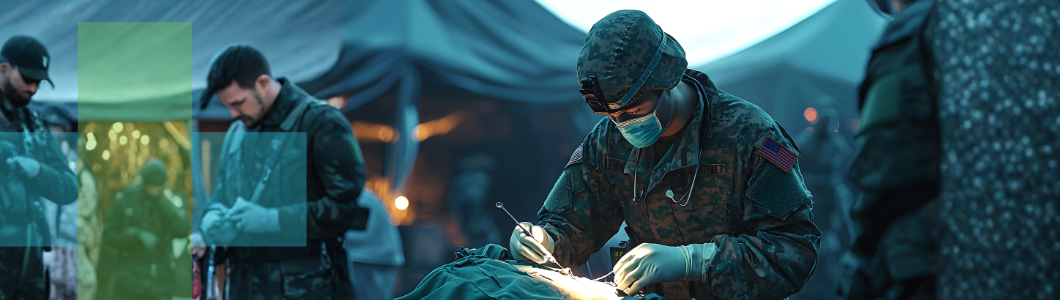
Special Operations Forces — the Delta operators, the Green Berets, the SEALs — deploy on missions where the margin is thinner than anything a hospital sees. Suppose one of those operators trains on a critical skill, then doesn’t touch it for fourteen months, and then has to perform it under fire, in the dark, with a teammate bleeding out in front of him. A course learned fourteen months ago and never practiced would not suffice. Lives would be lost.
So how do they keep their skills? Because they clearly do.
That question is the one healthcare has never seriously asked itself.
II. We Already Know This Works — We Lived It
Every clinician learned this way. We just stopped calling it training.
As an intern I learned how to start an IV, how to put in a central line, how to manage a sick patient on the floor at three in the morning. Those skills became second nature because the practice never stopped. Sometimes many times a day, sometimes once a day, but constant and continuous. That repetition is what built muscle memory. That repetition is what flattened the forgetting curve before it could form. That repetition is why, even now, you could wake me up from a dead sleep, hand me the right answer to find, and I would find it — because the training, the skills, and the knowledge had transcended into something subconscious.
That is high-frequency, low-dose training. Non-stop, until the response is no longer a decision. It is a reflex.
This is exactly what Special Operations Forces do. They repeat and repeat the same tasks until, in combat, the response is automatic — not thought through, not recalled, executed. Same principle, different domain.
It’s also how elite athletes train. No serious tennis player serves once a year and expects the serve to be there. No NBA shooter takes a thousand shots in February and assumes the muscle memory will carry through November. They drill the fundamentals daily, in short focused doses, forever. The cadence is the craft.
So why is healthcare behind?
It isn’t because we don’t know. Every intern knows. Every athlete knows. Every operator knows. The principle isn’t hidden — it’s been hiding in plain sight in our own training histories.
The honest answer is that the barriers are logistical and financial. We can’t pull a med-surg nurse off the floor every week for a procedural rep. We can’t staff a sim lab to run continuously for every shift on every unit. We can’t replicate the chaos of a real resuscitation in a classroom, on demand, on a Tuesday afternoon. So we don’t try. We default to the half-day course every two years and call it competency.
And the cost of that default falls in exactly one place. The only way clinicians currently maintain rare skills is on real patients — which means the patients pay the price of our practice, or worse, the price of our lack of it.
That is the part of this conversation we don’t say out loud often enough.
There is now a way out of the trade-off. Virtual reality healthcare training lets a clinician perform the skill on a continuous loop — short reps, frequent intervals, in an environment that approximates the real one closely enough to build genuine muscle memory. A small time commitment. A low-dose loop. No patient on the table. The training cadence the military and elite athletes have used for decades, finally available to a clinician at the start of a shift or the end of one, without pulling them off the floor and without anyone being harmed by their need to learn.
The principle isn’t new. The delivery mechanism finally is.
III. How the Military Solved the Same Problem
The military used to fail at this too
The military faced the same problem we face. Casualty care learned in a course got forgotten on the battlefield. The algorithms became a distant memory by the time they were needed. The result was mortality — preventable mortality, from injuries that should have been survivable. Trained didn’t mean ready. Certified didn’t mean competent. The gap between what was on paper and what happened under fire was costing lives.
Special Operations figured it out first
The Special Operations community — Delta Force, the Green Berets, the SEALs, Pararescue — solved it before anyone else, because they had to. Special Operations missions run on small teams. Austere environments. No nearby trauma center. The medic on the team often is the entire medical system for hours, sometimes days. When the margin is that thin, readiness can’t be a once-a-year event. The whole design has to be built around it. So they built it around it.
The doctrine: Tactical Combat Casualty Care
What came out of that work, in the mid-1990s, was a doctrine called Tactical Combat Casualty Care — TCCC. It started with a simple recognition: civilian trauma protocols, designed for a fully staffed emergency department, did not survive contact with a firefight. Casualty care under fire is a different problem, and it needs its own framework.
TCCC organizes that framework into three phases, tied not to the injury but to the tactical situation:
- Care Under Fire — what you do while you’re still being shot at. Minimal interventions. Hemorrhage control with a tourniquet is essentially the only priority. Get the casualty and the rescuer off the X.
- Tactical Field Care — once relative safety is established. Expanded assessment. Airway. Needle decompression for tension pneumothorax. Additional hemorrhage control. Analgesia.
- Tactical Evacuation Care — during transport to a higher level of care. Continued resuscitation, monitoring, preparing the casualty for surgical handoff.
Three phases, three different priority sets, all driven by the reality of where the patient actually is.
The training architecture: tiers, not one-size-fits-all
Doctrine alone doesn’t save anyone. TCCC’s second move — the one healthcare has never made — was a tiered training architecture. Not everyone trains the same. But everyone trains.
- Tier 1 — every service member. Hemorrhage control, tourniquet application, basic airway. Regardless of job, regardless of rank.
- Tier 2 — Combat Lifesaver. Designated non-medical personnel inside each unit. Expanded scope: needle decompression, advanced bleeding control, casualty movement.
- Tier 3 — Combat Medic and SOF Medic. Full procedural scope, including cricothyroidotomy, chest tubes, fluid resuscitation. Trains continuously.
Different roles, different scopes — but no role gets to opt out of frequent practice at its assigned tier. That is the architectural choice healthcare has not made.
The cadence: weeks, not years. Minutes, not hours.
This is the part civilians don’t believe until they see it.
Skills aren’t refreshed yearly or biennially. They’re touched in weeks. A SOF medic may run tourniquet reps, airway reps, and hemorrhage drills inside the same week, every week, indefinitely. A Tier 1 service member sees the core skills often enough that the forgetting curve never takes hold.
And the reps themselves are short. The unit of training is minutes, not hours. Five minutes of tourniquet drill done fifty times a year, but it buries an annual half-day course done once. The cadence is the craft. Frequency, not duration, is what builds the reflex.
That single inversion — from rare and long to frequent and short — is the entire engine of the model.
The proof
This isn’t theory. After TCCC was implemented force-wide, preventable deaths from extremity hemorrhage fell dramatically. Same anatomy. Same physics. Same human bleeding from the same artery. What changed was the doctrine and the cadence — and the survival data changed with it.
The military didn’t argue its way to better outcomes. It engineered a training system around the human nervous system as it actually works, deployed it at scale, and counted the casualties who didn’t come home in bags. The number went down. Then it kept going down. That is what an evidence base looks like when an institution takes readiness seriously.
What this means for hospitals
The military didn’t invent a new kind of human being. It engineered a training system around the human we already are — one whose skills decay, whose memory fades, whose hands need reps to stay sharp. That same human walks into a hospital every morning. The question is whether we will engineer for that reality or keep pretending we already have.
IV. Why Short and Frequent Beats Long and Rare
The brain wasn’t built for the half-day course
When we sit through a long class, the brain cannot register much from a single long session. The brain wanders, attention spans get shorter and shorter. That isn’t a failure of the learner — it’s a feature of how memory works. The brain consolidates learning from repeated exposures, spaced over time, rather than from a single heroic block of attention. The half-day course is fighting biology. The biology wins.
Muscle memory is built, not taught
Skill is a slow and repeated process. Malcolm Gladwell popularized the ten-thousand-hour idea, and the number is less important than the principle behind it: the hands and the nervous system learn by doing, not by being told. You cannot lecture someone into reliably and safely inserting a central line, a reliable compression depth, or a reliable airway. You can only put them through enough reps for the movement to become theirs. Muscle memory is built. It is never taught.
The forgetting curve doesn’t care about your certificate
Skills decay. The forgetting curve is real, and it is faster than the certification cycle pretends it is. Once you stop using a skill, the brain begins releasing it within weeks — not the two years stamped on the card. The certificate doesn’t slow the curve down. It just hides it from view.
Different skills decay at different rates
Decay is not uniform. Compressions decay differently from airway management. Pad placement decays differently from hand position. Each skill has its own half-life, governed by its own combination of cognitive load and motor complexity. A single annual session treats all of these skills as one undifferentiated lump. They are not one lump. They are a dozen separate clocks, all ticking at different speeds, and none of them ticking on the schedule the certification calendar imagines. Skills are learned at a different rate, and they decay at a different rate as well.
Stress changes everything
And almost every skill in healthcare is rehearsed in the wrong environment. The classroom is calm, well-lit, low-stakes — and the moment those skills are actually demanded, the environment is none of those things. Real clinical scenarios are loud, crowded, time-compressed, emotionally charged. A skill rehearsed only in a calm room is a skill that has never been tested under the conditions where it has to fire. The military trains the way it does for exactly this reason. The skill has to survive the stress, or it isn’t a skill yet. The solution is virtual reality medical training.
Reflex, not recall
This is why the goal of high-frequency, low-dose training isn’t to help people remember. It’s to build a reflex. A skill the clinician executes before conscious thought catches up. The half-day course aims for recall — can you describe the algorithm in six months? — and even at that, it fails. High-frequency training, ideally done through medical simulation training, aims at something different and more useful: an automatic, embodied response that fires when a patient is crashing, and there is no time to remember anything.
V. The Objections Collapse on Inspection
Healthcare can do exactly what the military did. We are sometimes too busy — and the military is busier. We worry about cost — and the cost we are already paying, measured in patient lives lost every year to skills that weren’t there when the moment came, is higher than any training budget. Every objection healthcare reaches for has been answered, somewhere, by an institution that took readiness seriously. The objections aren’t obstacles. They are defenses of a status quo no one wants to defend out loud.
None of this is insurmountable. The methods exist. The evidence exists. The model exists. What is missing is the decision to use them. Once that decision is made, the result is the only outcome that has ever mattered in this conversation: a clinician who does not freeze in the moment, who performs when it matters most, who does it reflexively, because the reps have already done the remembering for them.
VI. Monday Morning
The reason healthcare has defaulted to the half-day course isn’t philosophical. It’s logistical. Classrooms don’t scale to weekly. Manikin labs don’t scale to weekly. Faculty time doesn’t scale to weekly. The model healthcare needs has never been deployable at the cadence the science demands. That has now changed.
For a hospital leader reading this on a Monday morning, the next step is not a five-year plan. It is a ninety-day pilot.
Pick one high-stakes, low-frequency skill. Bag-valve-mask technique. Defibrillator pad placement. Hemorrhage control. Code-team role clarity. Anything where the gap between certified and ready is the part that costs lives. Audit the current cadence honestly — when did each member of the team last touch it, in their own hands, with feedback? Then run weekly five-minute reps for ninety days, and measure performance before and after. Not satisfaction. Not attendance. Performance.
Publish the result internally. Let the data make the next argument, the way the military let preventable-death numbers make theirs.
That is how a system this large changes. One unit, one skill, one ninety-day window at a time — until the cadence becomes the culture.
VII. The Gap Our Patients Fall Through
The military didn’t arrive at high-frequency, low-dose training by accident. It arrived there because the cost of unreadiness was paid in lives, in front of people who had to carry the bodies home. That visibility forced an honesty the system might otherwise have avoided.
Healthcare claims the same stakes every time we use the phrase patient safety. We say it in mission statements. We say it in board meetings. We say it on the walls of every hospital in the country.
The training model should match the rhetoric.
Until it does, the gap between certified and ready is a gap our patients fall through — and the only people who will ever close it are the ones who decide, on a Monday morning somewhere, that the cadence is finally going to change.

Farzad Najam
Table of Contents
Recent Blogs

The Day Healthcare Becomes Like Aviation
What a Real Competency Score Should Measure
Request a Pilot Consultation
Explore how VRKure can transform your medical training.