
From 1:6 to 1:30: How BLSXR Rewrites the Economics of Nursing CPR Training
- 10-15 mins read
Table of Contents
You walk in. Plastic manikin on a makeshift desk. Disinfectant in the air. The table is too high, or too low. The room is too hot, or too cold. This is where BLS CPR training happens.
The room is crowded. A buzz of conversation, scrubs against the wall, unknowns in the air. You try to count. Twenty-five? Thirty? Six manikins. One instructor.
The first six gather around a manikin. The rest of you wait. Phones come out. Waiting feels like a dose of slumber. Your eyes burn from the assignment you finished at two in the morning. Four hours of this? Side conversations pick up.
The instructor kneels beside the first manikin. Hands here. Compress. She moves to the next. Then the next. From the wall, you watch. The students push. The manikins make a sound. But what is the depth? Are the hands on the sternum, or sliding off? There’s no gauge. No mental image to match against. By the time the instructor reaches the sixth manikin, the first student is alone again, pushing into silence.
The morning ends. The rotation finishes. By the time it’s done, you’ve spent maybe eleven minutes with your hands on a manikin. Twelve, if you’re lucky. Attendance is documented. A certificate is handed out. The instructor did everything she could with thirty students and six manikins. You walk out with a card. BLS Provider. Valid for two years.
The instructor did her best. The students did theirs. The system fails both of them. Eleven minutes on a manikin, a card for two years, and a profession that depends on it. The question is not whether we can train harder. It’s whether the ratio itself has to hold.
* * *
The ratio has a source. The American Heart Association’s BLS Instructor manual specifies one instructor to six students for the classroom course. The course is built around two manikins per instructor, three students per manikin. Anything beyond six requires an additional instructor.
There is a reason for the cap, and the reason is honest: hands-on assessment requires eyes on the learner. One human instructor cannot observe and correct compression depth, hand placement, rate, and recoil for more than a small number of bodies at a time. The 1:6 ratio is a safety guarantee about the assessment tool itself — the human eye and the human ear. It says: if you want to verify competency by watching, here is the maximum number of people one human can watch.
It was set in a world where watching was the only option.
That world is ending.
* * *
BLSXR replaces the geometric constraint in BLS CPR training with a different kind of instructor.
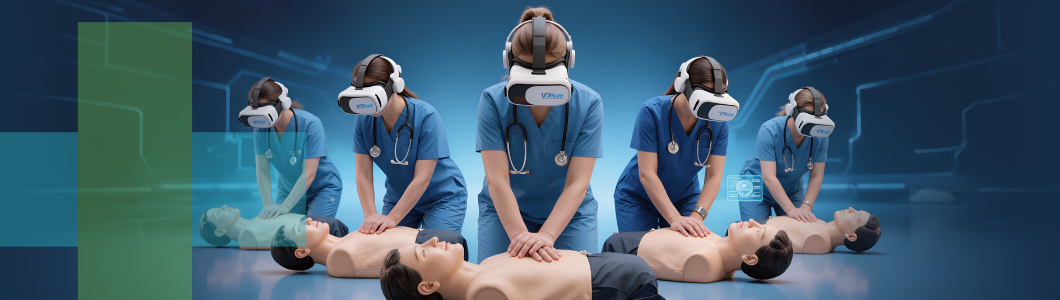
Dr. Hartwell is the AI coach inside the BLSXR headset. He is not a recording, not a video, not a script. He is a real-time observer with a perfect view of every student’s hands, every compression, every breath. He sees what a human instructor can only see one student at a time — depth, rate, recoil, hand placement on the sternum, ventilation volume.
He sees all of it, for every student, simultaneously.
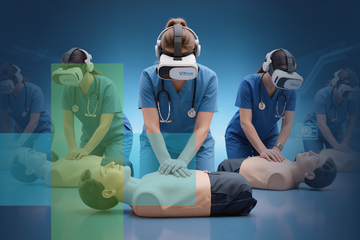
Thirty students in headsets. One Dr. Hartwell inside each headset, watching only that student. One human instructor in the room, watching the dashboard, coaching the outliers, validating the metrics. The human instructor is not replaced. She is amplified with the help of VR CPR training. For the first time, she has data on every student in her class, in real time, every second of the session.
The 1:6 ratio was an artifact of one constraint: one human can only observe a few learners at once. Lift that constraint, and the ratio collapses.
* * *
Run the math.
A nursing school of four hundred students needs BLS certification for every student. Under the 1:6 ratio, a class of thirty requires five instructors for four and a half hours — roughly twenty-two instructor-hours per class. At thirteen classes per year to cycle four hundred students, that is approximately three hundred instructor-hours annually. Plus manikin maintenance, consumables, room scheduling, and the choreography of getting thirty students into one room on one day.
Under BLSXR at 1:30, the same cohort is trained in BLS CPR training by one human instructor monitoring thirty headsets. Thirteen sessions a year. Roughly sixty instructor-hours.
A five-fold reduction in instructor time — and that is before the session itself is shortened, which the headset format also allows. Run the training in a thirty-minute high-frequency cadence instead of a four-hour annual block, and the math shifts again. Not toward less training, but toward more, distributed across the year, measured every time.
This is not the same CPR training for nurses, cheaper. This is different training, at a different price.
* * *
The obvious objection is that VR is less rigorous than hands-on.
Run the numbers the other way.
A four-and-a-half-hour BLS class delivers, per student, roughly seven minutes of actual chest compressions on a manikin. The rest is video, didactic instruction, watching partners, waiting in rotation, and the dozen other things that fill a classroom day. Of those seven minutes, very few are continuously observed. The instructor is moving among six manikins; the student is, for most of her compressions, alone.
A thirty-minute BLSXR session delivers roughly ten minutes of compressions per student — more than the classroom, in one-ninth the time. And every one of those compressions is measured. Depth. Rate. Recoil. Hand placement. Logged for every student, every session, every time.
The question is no longer whether VR is rigorous enough to replace the classroom. The question is whether the classroom, with its seven monitored-by-nobody minutes, is rigorous enough to keep up with the headset.
* * *
The 1:30 ratio is not a cost-cutting move. It is a competency move.
For decades, nursing schools have done the best possible nurse CPR training inside an impossible constraint — six students per instructor, seven minutes of compressions per student, a card valid for two years. The instructors have given their best. The students have given theirs. The system has failed both.
What changes with BLSXR is not the speed of the training, or the price, or the convenience. What changes is what the certification card means.
The card no longer says you attended a four-hour class. It says every compression you have ever performed has been measured — depth, rate, recoil, hand placement, every time. It says the next time you walk into a Code Blue, your hands have been trained against data, not against attendance.
That is the version of competency the profession deserves.
That is what 1:30 is for.

Farzad Najam
Table of Contents
Recent Blogs
Request a Pilot Consultation
Explore how VRKure can transform your medical training.