When Practice Became Critical Readiness
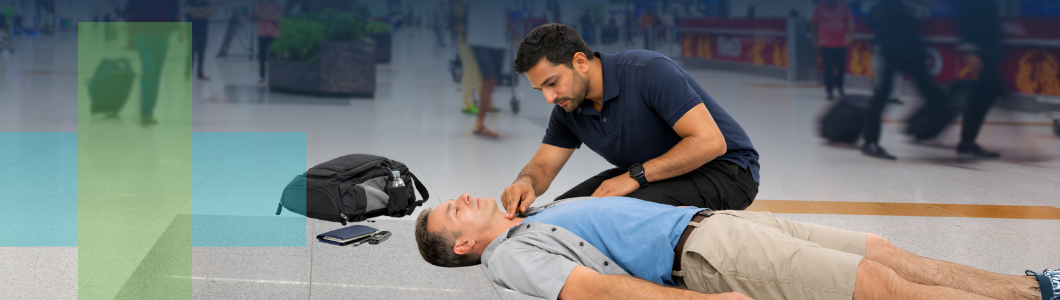
During his return from a business trip in Manila, VRKure’s software lead, Sourav Pandey, was faced with a harrowing situation at the airport where his VR medical training became the critical factor in ensuring the well-being of a fellow passenger.
Sourav was waiting his turn in the immigration queue. Suddenly a traveler at the counter collapsed, lost consciousness, and fell face-first to the ground. The crowd of waiting passengers froze with just one person moving to catch him. Sourav rushed forward to assess.
He helped remove the traveler’s bag from his back, cleared the space, and laid him flat on the floor. Then Sourav’s training took over. He first checked the traveler’s breathing and found he was breathing heavily. He opened the airway by lifting the man’s chin, so he could breathe more easily.
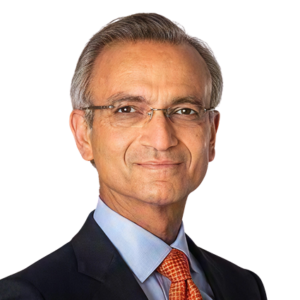
Next, Sourav proceeded to tap the man on his shoulder and checked for responsiveness by asking if he could hear him. When the man responded, Sourav knew this was not a situation for immediate CPR. He called Dr. Farzad Najam (CEO, VRKure) for clinical confirmation.
Dr Najam reaffirmed Sourav’s assessment that the man was not experiencing a cardiac arrest, and advised him to simply wait for the medics to arrive. Sourav ensured that the traveler remained responsive by engaging him in light conversation until the airport medical team appeared. The medics subsequently assessed the episode as an anxiety attack.
The critical outcome was not dramatic intervention; it was correct restraint. Sourav did not panic, did not start unnecessary chest compressions, and did not waste the first minutes guessing. He followed the basic sequence in alignment with the principles of BLS training: assess responsiveness, check breathing, support airway, activate help, and monitor until professionals take over.
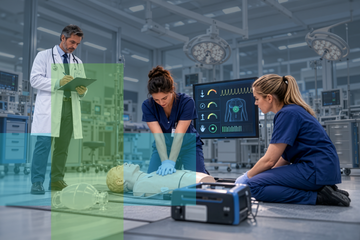
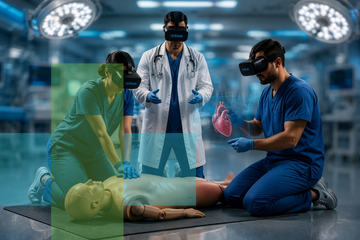
That is where BLSXR proves its value. VRKure’s flagship immersive medicine platform is a headset-native, fully offline simulator that trains and verifies Basic Life Support competency through real-time biometric feedback and mastery-gated progression. Learners do not advance because they completed seat-time. They advance when they demonstrate competency.
This matters in clinical and public environments because emergency skills invariably decay over time. BLSXR is designed around the vital principle that competency must be measured and reinforced continuously, not certified once a year.
In Manila, VR was not the story. Patient safety was. Prior medical simulation training with BLSXR became calm, structured, on-ground execution.