


The Competency Paradox: Medicine Measures Everything Except the People Who Practice It
- 10-15 mins read
Table of Contents
Consider a patient in a cardiac surgical intensive care unit on the first night after an operation. Arterial pressure is displayed with every heartbeat. Oxygen saturation is continuous. Urine output is charted by the hour. Blood is drawn and analyzed several times before morning. The ventilator logs its own settings and alarms. The infusion pumps record every rate change. Weeks later, the outcome of the operation will be entered into a registry and compared with national benchmarks.
Few industries measure their work this thoroughly. Medicine is right to do so.
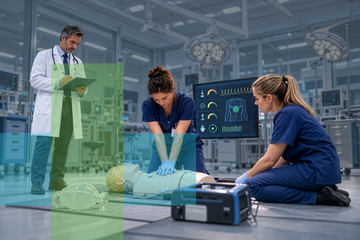
Now ask a different question about the same night. How well can the nurse at that bedside perform chest compressions right now? When did the resident covering the unit last run a resuscitation, and how did it go? What are the performance metric of the surgeon? When was the last time a provider demonstrated competency in objective terms? Nobody in the building can answer with data. In most hospitals, the important question about clinical competency assessment is not even asked.
I call this the Competency Paradox. Medicine measures nearly everything except the current ability of the people who practice it. It is a glaring contradiction.
The stakes are counted in hundreds of thousands
This is not a niche concern. Researchers working from national registry data estimated that about 292,000 adults suffer cardiac arrest inside United States hospitals each year. That figure, published by Holmberg and colleagues in 2019, is a model-based estimate, but its scale is not in doubt. Every one of those events is answered by whoever happens to be on duty.
The hospital knows that patient’s last potassium value to one decimal place. It does not know when the responding team last practiced, or how well they performed when they did.
Resuscitation is not the only skill this applies to. It is simply the clearest case, because it is rare, time-critical, and entirely dependent on skill that cannot be looked up in the moment.
Our checks are timed for paperwork
Medicine does check its people. Joint Commission standards require staff competence to be assessed at orientation and documented at least every three years. Many hospitals set shorter intervals, and many units do more than the minimum.
But look at what these checks are. They are periodic snapshots of healthcare staff competency assessment, timed by administrative cycles and often recorded as a signature confirming that a skill was observed. Between snapshots, the system assumes. It assumes that whoever was competent at the last check remains competent today; competence defined in subjective rather than objective terms. For a skill that fades within months, that assumption carries a great deal of weight.
Aviation stopped assuming
Commercial aviation faced a similar problem and chose a different answer. Under federal rules, an airline captain’s skills are formally checked at least every six months, in a simulator or in the aircraft. Not every pilot is on that six-month schedule, but the principle is plain. The industry does not accept that a captain who handled an engine failure well last year will handle one well today. It checks.
Pilots do not take this as an insult. Recurrent checking is part of being a professional in a field where error is costly and rare events must be handled well. I will return to what aviation learned, and what medicine might borrow, later in this series. For now the contrast is enough. One high-stakes profession treats skill as perishable and measures it on a schedule matched to that fact. The other measures its instruments with great care and leaves the skill of its people largely unrecorded.
Measuring clinicians is a form of respect
Some clinicians hear “measurement” and think “surveillance.” I understand the reaction. Too much of what passes for measurement in health care is compliance tracking that tells the clinician nothing useful.
Real measurement of BLS competency assessment gives clinicians what we already give patients: objective data, trended over time, used to act early rather than late. A clinician who can see that a skill has drifted can address it in a short practice session. A unit leader who can see readiness across a team can direct support where it is needed, before an arrest exposes the gap.
This is the idea behind BLSXR™, the clinical competency intelligence assessment and verification system we at VRKure built for basic life support. Clinicians who are already certified complete short sessions, receive objective scores, and can take an unassisted assessment that adds to a record over time. It does not replace instructor-led certification. It measures what happens after it.
The Competency Paradox is not a story about bad clinicians. It is a story about a system that built extraordinary instruments for everything except its own people. That part can be fixed.
Sources
- Holmberg MJ, Ross CE, Fitzmaurice GM, et al. Annual Incidence of Adult and Pediatric In-Hospital Cardiac Arrest in the United States. Circulation: Cardiovascular Quality and Outcomes. 2019.
- The Joint Commission. Heads-Up report on competency assessment. 2020.
- Code of Federal Regulations, Title 14, Section 121.441. Proficiency checks.

Farzad Najam
Table of Contents
Recent Blogs

The Card in Your Wallet Proves You Showed Up. Nothing More.

The Day Healthcare Becomes Like Aviation
What a Real Competency Score Should Measure
Request a Pilot Consultation
Explore how VRKure can transform your medical training.