


The Day Healthcare Becomes Like Aviation
- 10-15 mins read
Table of Contents
It is a Tuesday morning, some years from now. A sixty-four-year-old man is being admitted for complex heart surgery. His daughter has not searched for the surgeon online. She has not called a friend who is a nurse. She has not asked whether the night staff are any good.
She has no reason to. The hospital states it publicly: every person who will touch her father has shown, within the last ninety days, that they can do what their job requires. Not attended a class. Shown it, measured, on record. That includes the surgeon. He is certified on a simulator driven by artificial intelligence, where he had to demonstrate that he can perform the operation with correct technique.
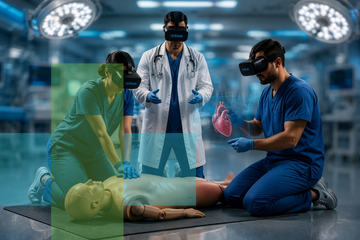
Down the hall, a nurse begins her shift. Last Thursday she spent three minutes in a VR headset. Her compressions were a little shallow in the second minute. The VR BLS training system told her, she corrected it, and the result was logged. The system also tracks how quickly her skills fade. It has already scheduled her next session, timed to come before the decay sets in. Nobody on the unit thinks this is unusual. It is as routine as washing hands.
That is the day healthcare becomes like aviation. I spent twenty-six years as a cardiac surgeon waiting for it.
Aviation Did Not Get Safe by Accident
It is easy to assume flying was always this way. It was not.
In 1977, two Boeing 747s collided on a runway in Tenerife and 583 people died. In 1978, a United Airlines crew circled Portland working on a landing gear problem until the airplane ran out of fuel. Ten people died. Neither crash involved a pilot who lacked a license. Both crews were certified, experienced, and respected.
Aviation learned the hard truth from those incidents. A license is just a snapshot of what was learned the day of the test. It says nothing about today. So the industry stopped relying on the license alone and built a system around it, a system that could measure skills objectively.
Airline pilots now return to the simulator on a fixed schedule, every six to twelve months, for their entire careers. They practice the engine failure and the cabin fire they hope never to see. Every flight is recorded. When something goes wrong, the recording is studied and the lesson is shared across the industry.
And there is a consequence. In the United States this is federal regulation, not a guideline. A captain must pass a proficiency check every twelve months and return to the simulator every six. A pilot who cannot demonstrate satisfactory performance may not fly for the airline until the check is passed. Seniority does not change that. Thirty years of experience does not change that.
None of this was voluntary. Regulators required it. There was resistance at first. Today no pilot would want to fly without it.
Credentialing Counts Cases. It Does Not Measure Skill.
Now consider how a hospital decides that a surgeon may keep operating.
Every two years, my privileges came up for renewal. For each procedure, I entered the number I had performed in the last twenty-four months. The hospital kept its own count of my cases and tracked my outcomes. What nobody did was watch me operate. Nobody measured my technique.
Hospitals do more than collect a form. The Joint Commission requires an ongoing professional practice evaluation, a review of each clinician’s data at least once a year. It is built mostly on numbers. Watching a surgeon operate is permitted, but it is not required. One study of six hospital systems and 12,854 clinicians found that in the most recent annual cycle this review, on its own, led to a change in privileges for none of them.
In medicine, volume is perceived as quality. But volume is not skill. A surgeon can perform a procedure fifty times and perform it poorly fifty times. A surgeon can do it well for twenty years and slip in the twenty-first. A case count cannot tell the difference, and we have no other way to know.
A pilot does not stay in the cockpit on logged flight hours alone. The pilot goes back to the simulator and demonstrates the skill. In medicine, the review stops at the count. It never reaches quality.
What the Hospital of the Future Looks Like
With VR in medical training, competency shall be checked every few weeks, not every two years. A Basic Life Support card is valid for two years. Research shows the skills behind it begin to fade within three to six months. In the hospital of the future, nobody carries a two-year card. They carry a status that is either current or not, kept current by short practice sessions every few weeks.
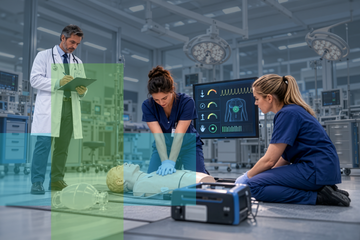
Competency shall be measured. Today an instructor watches a learner push on a manikin and decides it looks about right. That is not good enough, because the target is narrow and still debated. Guidelines call for five to six centimeters. A study of more than 9,000 patients found the best survival closer to four and a half. Push deeper than six, and one hospital study found injuries such as rib fractures in nearly half of patients. The margin is about one centimeter. Studies show instructors cannot judge it reliably by eye. In the hospital of the future, compression depth, rate, recoil, and time to the first compression are objective numbers. Numbers do not get tired, and they do not have a class to finish before lunch.
Competency shall be visible, measurable, and auditable with BLS VR training for hospital staff. A charge nurse building the night schedule can see who is current on which skills, the way an airline knows which pilots are current on which aircraft. The hospital’s board receives a report on how many of its staff are current on each life-saving skill, just as it receives a report on infection rates. Every practice session is saved, so an accrediting body can check the record instead of taking the hospital’s word for it. In time, patients can look up the same information.
Credentialing shall be earned. The right to perform a procedure no longer rests on a case count. The surgeon demonstrates the procedure on a simulator, the technique is measured, and the credentialing committee reviews performance instead of a number on a form.
And when a real cardiac arrest happens, it is reviewed the way a flight is reviewed. Not to assign blame. To learn what the team did in the first two minutes, and to practice what was missed.
What Has to Change First
Technology is no longer the obstacle. A headset can place a nurse inside a cardiac arrest and measure every compression, the breathing rate, and the time to defibrillation. The obstacle is inertia. “It has been working for a long time,” people say. It has been in place for a long time. That is not the same as working. Inertia shows up in four ways.
The first is treating attendance as ability. A card shows that someone sat through a course. It was never designed to show what their hands can do eighteen months later.
The second is the calendar. One long class every two years is convenient to schedule and poorly matched to how skills fade. The evidence favors short practice, done often.
The third is the hardest. We have to be willing to see the results. Measurement will show that some experienced, well-liked clinicians cannot perform a skill they are certified in. I include physicians. Aviation faced the same discomfort and decided the passenger mattered more than the pilot’s pride.
The fourth is that someone has to require it. Aviation changed when regulators made it a condition of flying. Healthcare will change when accrediting bodies, state boards, and malpractice insurers stop asking whether the staff is certified and start asking two different questions. Are they competent? Have their competency and skills been verified?
Where It Starts
I built BLSXR to be one piece of that day. It is a virtual reality platform for Basic Life Support. It places the learner inside the emergency, measures what their hands do, and keeps the record. It is portable. It runs on a headset, with no manikin and no classroom. It starts with Basic Life Support because every clinician needs it and almost no one practices it enough.
There is a fair criticism. A headset cannot reproduce the resistance of a chest under the hands. A manikin can. But it is worth asking what that feel has delivered. Clinicians trained on manikins still misjudge depth. Ribs still fracture. Within months, the skill has faded. The feel of the manikin has not solved the problem. What the manikin class lacks is measurement and repetition, and those are what BLSXR provides.
BLSXR is one skill. The same method can apply to every skill a hospital credentials. VRKure’s clinical competency verification platform is designed for that. The clinician demonstrates the skill in a headset, the performance is measured, and the record can travel with the clinician from one hospital to the next. Aviation did not build its system in a year either.
But I no longer think the day is far off. The tools exist. The evidence on skill decay has existed for decades. Yet hospitals still do not objectively measure it in their own staff. What is missing is the decision.
A patient should be able to trust a hospital the way a passenger trusts an airline: without knowing a single name. That day is coming. I intend to help it arrive sooner.

Farzad Najam
Table of Contents
Recent Blogs
The Day Healthcare Becomes Like Aviation
What a Real Competency Score Should Measure
Request a Pilot Consultation
Explore how VRKure can transform your medical training.