

The Missing Link in BLS Training: From Certification to Real-World Readiness
- 10-15 mins read
Table of Contents
A healthcare professional completes a Basic Life Support course in an afternoon. They pass the assessment. They receive the card.
Eight months later, an alarm sounds. A patient collapses. Decisions have to be made in seconds.
Is that professional ready?
Healthcare is beginning to name a gap it has lived with for years: certification measures completion, but readiness requires continuous competency. They are not the same thing.
Knowing CPR Is Not the Same as Performing CPR
Traditional BLS training built the foundation for emergency preparedness, and that foundation still matters. It supplies the structure, the clinical guidelines, and the core knowledge every responder needs.
But a certificate is not evidence of competence, confidence, or accuracy under pressure.
Cardiac arrest does not happen in a classroom with clear instructions, predictable timing, and an instructor standing a few feet away. It happens without warning, and it demands fast decisions, coordinated teamwork, and precise execution in conditions no one controls.
Knowledge alone does not carry a team through that. Knowledge has to convert into action, immediately.
Skill Decay: What Happens After the Card Is Issued
Skill retention is one of the hardest problems in healthcare training. Under the traditional model, learning stops the moment certification is granted, and the evidence is blunt about what follows. The American Heart Association’s own resuscitation education guidelines note that CPR skills acquired immediately after BLS training often show decay by as early as three months.
Certification cycles run two years.
The AHA’s response is not more classroom time. It gives booster training a Class 1 recommendation, and the research behind it found a dose-dependent effect: the more frequently teams practiced, the better their CPR skills held up at twelve months. Spaced learning, distributed across weeks or months instead of compressed into a single day, carries a Class 2a recommendation.
CPR is especially vulnerable because it is not a knowledge task. It is a physical, timed, coordinated one that depends on depth, rate, rhythm, hands-off time, and composure.
A provider can recite the guidelines perfectly and still struggle to:
- maintain correct compression depth and rate
- sustain quality through a prolonged resuscitation
- adapt when the scenario changes mid-event
- decide clearly while managing their own stress
Which raises the question most organizations have not answered: how do you know your team is ready between certification cycles?
From Completion to Verified Performance
For decades, healthcare training has followed a completion model: attend the course, pass the assessment, receive the certification.
The standard now moving into place asks harder questions:
- Can performance be measured?
- Can improvement be tracked?
- Can readiness be verified?
Other high-risk industries made this shift long ago. Pilots do not rely on classroom instruction before taking an aircraft up; they return to the simulator on a schedule, for their entire careers. Emergency responders drill to keep decision-making sharp under pressure.
Healthcare is moving in the same direction, not by replacing traditional training, but by reinforcing it with practice that is realistic, repeatable, and measurable.
That is where simulation earns its place. Immersive scenarios let learners rehearse the event itself as many times as they need, with feedback that arrives while the attempt is still fresh.
Why Real-Time Feedback Changes the Learning Curve
In CPR, the details are the outcome:
- compression depth
- compression rate
- hands-off time
- rhythm consistency
- response timing
Traditional training leans on instructor observation. That judgment is valuable, but it is bounded by time, class size, and subjectivity, and it usually arrives after the fact.
Objective, real-time feedback changes that. When a learner can see exactly where compressions fell shallow or pauses ran long, the next repetition becomes a correction rather than a guess:
- Was compression depth in range?
- Was the rhythm consistent?
- Were pauses minimized?
- Did the learner act correctly at the decisive moments?
Practice stops being repetition and starts being improvement.
Virtual Reality and the Readiness Gap
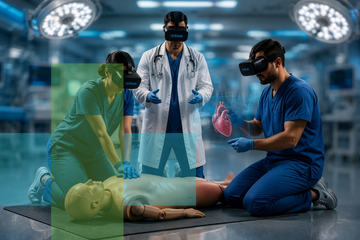
Virtual reality gives healthcare professionals somewhere to fail safely: a realistic environment to practice in, with no patient at risk.
Conventional simulation offers that too, but at a cost in dedicated space, equipment, staffing, and scheduling that limits how often anyone actually trains. VR reduces that overhead, which is what makes repetition realistic rather than aspirational.
VRKure‘s BLSXR™ applies this to BLS specifically: immersive scenarios that replicate real decision-making and response conditions, with performance data captured on every attempt, so competency becomes something an institution can see rather than assume.
Building Toward Measurable Clinical Readiness
The future of BLS training will not be defined by certificates earned. It will be defined by skills retained, confidence built, and performance verified.
Closing the gap between the classroom and the code lets healthcare institutions move from training completion toward genuine emergency readiness.
Because when a life depends on the next few seconds, readiness cannot simply be taught.
It must be practiced.
See what measurable BLS readiness looks like at your institution — request a BLSXR™ demo.

Farzad Najam
Table of Contents
Recent Blogs

The Day Healthcare Becomes Like Aviation
What a Real Competency Score Should Measure
Request a Pilot Consultation
Explore how VRKure can transform your medical training.